
Play Tower Rush Now!
Home → Mobile
Tower Rush Mobile
Tower Rush on mobile
The Galaxsys studio released Tower Rush in 2024, a crash game that functions without reels or paylines. This instant play format allows players to stack floors while the multiplier rises toward a maximum of x100. Mobile users access this specific mechanic directly through their device browser without needing additional software installations.
The theoretical return is set at 97.00%, meaning the house edge stands at 3.00% over long sessions. Operators may configure alternative RTP values ranging from 96.2% to 97.6% depending on bonus floor settings. Players must cash out before the tower collapses to secure any winnings from these varying return rates.
In contrast, Chicken Road offers an RTP of 98.00% with a massive max win potential of x3,608,855. Tower Rush caps its maximum payout significantly lower at just 100x the initial stake. This structural difference defines the risk profile for mobile players choosing between these two distinct crash mechanics.
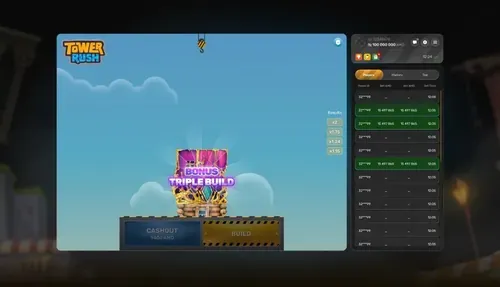
Playing in the mobile browser
The HTML5 architecture ensures Tower Rush runs smoothly on iOS and Android devices without requiring downloads. Galaxsys optimized the provably fair hash verification process for smaller screens and variable network conditions. This technical approach maintains game integrity while adapting to the constraints of mobile internet connections.
Cash out decisions happen instantly as the multiplier climbs, demanding quick reaction times on touchscreens. The auto cashout feature mitigates latency issues by executing trades based on pre-set numerical thresholds. Players can define exact multipliers to trigger withdrawals automatically during high-speed rounds.
Chicken Road utilizes InOut Games technology to deliver similar instant gameplay but with different volatility characteristics. Its higher max win of x3,608,855 contrasts sharply with Tower Rush's conservative 100x cap. Browser-based play remains consistent across both titles despite these divergent reward structures.
Screen layout on phones
The vertical interface displays the rising tower and current multiplier prominently for thumb-friendly interaction. Special bonus floor types like Frozen Floor and Temple Floor appear as distinct visual markers on the screen. These graphical elements help players track progress toward the maximum x100 multiplier without cluttering the display.
Game controls remain accessible within easy reach, allowing immediate adjustments to bet sizes or auto-cashout limits. The layout prioritizes clarity over decoration, ensuring critical data like the 97.00% RTP stays visible. This design choice supports rapid decision-making during fast-paced rounds where seconds matter.
Comparative analysis shows Chicken Road employs a wider horizontal layout due to its road-building theme. InOut Games designed that interface to accommodate longer sequences leading up to its x3,608,855 potential. Tower Rush’s compact vertical stack suits shorter, more intense sessions capped at 100x wins.
Touch controls and buttons
Tapping the cashout button stops the multiplier rise, securing profits before the tower collapses randomly. Galaxsys implemented responsive touch targets to prevent accidental triggers during high-stress moments. The interface requires deliberate input, reinforcing the strategic nature of each round's outcome.
Auto cashout settings allow players to predetermine exit points based on specific multiplier values. This feature protects against human error when attention lapses during extended gaming sessions. Users can adjust these thresholds dynamically as they navigate through different bonus floor types.
Chicken Road features similar touch mechanics but focuses on navigating a path rather than stacking towers. InOut Games adjusted control sensitivity to match its unique progression system leading to x3,608,855. Tower Rush simplifies interaction by limiting choices to bet size and single-action cashouts.
Performance on older devices
The lightweight codebase ensures Tower Rush loads quickly even on hardware several years old. Galaxsys minimized asset sizes to maintain smooth animation during the rising multiplier phase. This optimization preserves the core experience regardless of the device's processing power or memory capacity.
RNG calculations occur locally or via secure servers, reducing dependency on high-bandwidth connections. The 97.00% RTP calculation remains accurate despite minor frame drops on legacy smartphones. Provably fair verification continues functioning reliably, ensuring transparency for all participants in the game.
Tower Rush: key facts
| Parameter | Value |
|---|---|
| Game | Tower Rush |
| Studio | Galaxsys |
| Released | 2024 |
| RTP | 97.00% |
| House edge | 3.00% |
| Max win | 100x |
Data use during play
The Galaxsys studio released Tower Rush in 2024 as a crash game that relies on real-time server communication to calculate the rising multiplier for each round. This constant data exchange ensures the provably fair hash verification works correctly, requiring a stable internet connection to prevent disconnects during critical cash-out moments. Players must maintain connectivity to ensure their withdrawal requests are processed before the tower collapses, avoiding any loss of potential winnings.
A theoretical return of 97.00% indicates the house edge is exactly 3.00%, which affects long-term bankroll management more than short session variance. Operators may configure alternative RTP settings ranging from 96.2% to 97.6%, meaning the actual mathematical expectation varies depending on the specific casino platform used. This configuration difference alters the expected loss rate per unit wagered, influencing strategic decisions about bet sizing and session duration significantly.
Mobile users should monitor their data consumption carefully since each floor stack generates multiple API calls for state updates and final settlement calculations. The maximum win cap of 100x limits the total payout per round, capping the financial impact of any single successful high-multiplier sequence. Understanding these limits helps players manage expectations regarding potential returns without relying on misleading promotional materials or inflated win claims.
Playing on unstable connections
Network instability poses a significant risk when playing Tower Rush because the game requires precise timing for cashing out before the multiplier crashes. A dropped connection during a rising multiplier sequence results in automatic forfeiture of the stake, as the system cannot process manual intervention commands. This mechanic emphasizes the importance of reliable broadband or strong mobile signal strength to avoid unintended losses during critical gameplay moments.
The developer Galaxsys designed the game with an auto cashout feature that mitigates some latency risks by executing predefined exit strategies automatically. Players can set a target multiplier value that triggers the withdrawal before the tower potentially collapses, reducing reliance on human reaction speed under poor network conditions. This automated safeguard ensures consistent execution of betting plans even when internet connectivity fluctuates during active gaming sessions.
Unstable connections also affect the display of the provably fair hash verification process, which confirms the integrity of each round's outcome independently. Without a stable link, players might miss the cryptographic proof needed to verify fairness, leaving them unable to audit the randomness of the collapse point. Maintaining connectivity allows full access to transparency tools that protect against potential manipulation by malicious actors or software bugs.
The maximum multiplier reaches x100, creating high-stakes moments where even a brief delay in cashing out can mean the difference between winning and losing the entire bet. Players should test their connection stability before committing significant funds to ensure they can execute trades reliably during these volatile sequences. Proper preparation minimizes the impact of technical issues on overall profitability and player satisfaction levels consistently.
Battery drain in long sessions
Running Tower Rush continuously on mobile devices consumes battery power rapidly due to the intensive graphics rendering required for the tower-building animation effects. Each successful floor stacking involves complex visual transitions that demand significant processing resources from the device's GPU, accelerating energy depletion over time. Users planning extended gaming sessions should keep their devices plugged in to avoid unexpected shutdowns during critical cash-out opportunities.
The theoretical return of 97.00% suggests a relatively low house edge compared to many other instant games, but this efficiency does not reduce hardware strain. The game runs at high frame rates to ensure smooth multiplier progression, which keeps the processor active and prevents power-saving modes from activating. This constant activity drains batteries faster than simpler text-based or static image games, requiring careful energy management during prolonged play.
Galaxsys optimized the code for modern smartphones, yet the dynamic nature of crash games inherently requires more computational effort than static slot simulations. The auto cashout feature reduces input frequency slightly, but the background processes for hash verification and real-time odds calculation remain active throughout. Monitoring battery levels helps prevent mid-session interruptions that could result in forfeited wins if the device powers down unexpectedly.
The maximum win cap of 100x means players often engage in rapid successive rounds to chase higher multipliers, increasing screen-on time significantly. This behavior pattern exacerbates battery drain, especially when combined with high brightness settings necessary for visibility in various lighting conditions. Strategic breaks between sessions help preserve device health and ensure optimal performance when returning to high-stakes gameplay environments.
Portrait and landscape modes
Tower Rush supports both portrait and landscape orientations, allowing players to choose the viewing angle that best fits their physical environment and hand position. The Galaxsys interface adapts dynamically to screen dimensions, ensuring the tower visualization remains clear and accessible regardless of device rotation. This flexibility enhances usability for users who prefer holding their phones vertically while commuting or sitting in confined spaces comfortably.
The theoretical return of 97.00% applies equally across all orientation modes, meaning the mathematical expectation remains unchanged whether playing vertically or horizontally. However, landscape mode provides a wider field of view for the multiplier graph, making it easier to track progress toward the maximum win cap of 100x. This visual advantage helps players make quicker decisions about when to cash out based on clearer trend analysis and spatial awareness.
Landscape orientation often feels more immersive for desktop-like experiences, while portrait mode suits quick, casual sessions on smaller screens effectively. The auto cashout function operates identically in both modes, ensuring consistent execution of pre-set strategies without regard to display configuration. Players can switch orientations freely during breaks without affecting game state or losing any accumulated progress toward bonus floors or multipliers.
The maximum multiplier of x100 creates intense moments where wide-angle views in landscape mode help players gauge risk versus reward more accurately. Portrait mode may compress the visual data slightly, requiring closer attention to numerical readouts rather than graphical trends for precise timing. Understanding these differences allows users to select the optimal setup for their skill level and preferred style of engagement consistently.
Sound and animation settings
The Galaxsys studio includes customizable sound effects that accompany each floor stack and the final tower collapse, enhancing the sensory feedback loop during gameplay. These audio cues provide immediate confirmation of successful actions, helping players stay engaged without needing to constantly monitor visual elements closely. Turning off sounds reduces distraction in quiet environments while maintaining full access to all game mechanics and statistical displays effectively.
Animations render the rising multiplier curve with smooth transitions, reflecting the theoretical return of 97.00% through visually appealing growth patterns that build tension gradually. Disabling heavy graphical effects improves performance on older devices, though the core logic remains identical regardless of visual fidelity settings chosen. This balance ensures accessibility for users with varying hardware capabilities while preserving the essential experience of chasing the maximum win cap of 100x.
The house edge of 3.00% is embedded in the mathematical model behind every animation frame, determining how quickly the tower typically collapses relative to bets placed. Visual representations do not alter the underlying RNG outcomes, serving purely as aesthetic enhancements to accompany the provably fair verification process transparently. Players relying on strategy should focus on numerical data rather than graphical flair when making critical cash-out decisions during volatile rounds.
The maximum multiplier reaches x100, triggering distinct celebratory animations that reinforce the psychological reward of successful high-risk plays. These visual rewards are independent of the actual monetary value won, focusing instead on gamification elements that encourage continued participation. Adjusting animation intensity allows users to tailor the experience to their personal tolerance for stimulation and desire for minimalistic versus immersive interfaces.
Phone versus desktop play
The Galaxsys studio released Tower Rush in 2024 as a crash game featuring a theoretical return to player of 97.00% across its standard configuration. This specific percentage represents the house edge of 3.00%, which remains constant regardless of whether the interface displays on a compact smartphone screen or a large desktop monitor. The mathematical expectation for the player does not shift with device size, ensuring that the long-term statistical advantage stays fixed at the stated value.
The maximum win cap stands at 100x the initial stake, a limit that applies uniformly to all platforms without any reduction for mobile users. While the visual presentation adapts to fit smaller screens, the core mechanic involving a rising multiplier and cash-out decision remains identical to the desktop version. Players retain full access to the auto cashout feature on both devices, allowing them to secure profits before the tower collapses at any point during the round.
In contrast, other titles like Aviator by Spribe offer a significantly higher maximum win potential of x1,000,000 despite sharing the same 97.00% RTP figure. This comparison highlights how Tower Rush limits the upside to 100x while maintaining a competitive return rate through its unique tower-building structure. The lower ceiling reduces variance compared to high-multiplier crash games, providing a more controlled risk profile for players who prefer steady progression over extreme outliers.
Tablet experience
Tablet devices provide an intermediate display size between phones and desktops, offering sufficient space to view the full tower structure without excessive scrolling. The 97.00% RTP figure remains unchanged, meaning the theoretical return over hundreds of thousands of rounds is identical to that experienced on larger monitors. The tactile interaction on a tablet allows for precise tapping when selecting floors, which may improve the timing accuracy for cashing out before the collapse occurs.
The special bonus floor types, including Frozen Floor, Temple Floor, and Triple Build, are clearly visible on tablets due to their larger screen real estate. These RNG-based features introduce additional multipliers that stack onto the cumulative odds, enhancing the potential payout within the 100x maximum win cap. The provably fair hash verification system operates identically, ensuring that the integrity of each round is maintained regardless of the device used for gameplay.
The 3.00% house edge persists across all hardware configurations, so players should expect the same long-term statistical outcome on a tablet as on any other platform. Unlike slots, this instant game relies on a single rising multiplier per round rather than spinning reels or landing symbols, making the visual clarity on tablets particularly beneficial. Users can easily track the multiplier's ascent and execute cash-outs with minimal delay, optimizing their strategy within the constraints of the fixed return rate.
What changes on a small screen
On small screens, the primary challenge involves managing the interface elements while tracking the rising multiplier toward the 100x maximum win cap. The Galaxsys studio designed the game to remain functional on compact devices, though the reduced visibility may require players to rely more heavily on the auto cashout feature. The 97.00% RTP figure remains unaffected by screen size, ensuring that the mathematical fairness of the game is preserved regardless of the physical dimensions of the display.
The three special bonus floors, such as Frozen Floor and Temple Floor, still trigger randomly but may appear less prominently on smaller displays. Players must navigate these events carefully, as missing a prompt could result in losing the accumulated multiplier before reaching the cash-out stage. The house edge of 3.00% ensures that the operator retains a consistent advantage, so users should approach each round with realistic expectations about potential returns.
Compared to Aviator by Spribe, which offers a massive x1,000,000 max win, Tower Rush restricts payouts to 100x, making screen size less critical for spotting rare high-value outcomes. The lower maximum win cap means that even on a small screen, players can achieve significant relative gains without needing to chase extremely rare multipliers. This design choice aligns with the game's crash mechanics, where timing the cash-out is more important than waiting for astronomical wins.
Interrupted rounds and reconnects
If a connection drops during a round, the game state is determined by the last confirmed action before the interruption occurred. Since Tower Rush uses a provably fair RNG system based on hash verification, the outcome of each floor is pre-determined and cannot be altered upon reconnection. The 97.00% RTP figure assumes continuous play, so interruptions do not affect the long-term statistical return but may disrupt short-term session goals.
The maximum win cap of 100x applies to the final result after all floors are completed or the tower collapses, regardless of network stability. If a player successfully cashes out before disconnection, the winnings are secured and credited to the account immediately. In cases where the tower collapses before a cash-out command is processed, the entire stake is lost, reflecting the inherent risk of the crash mechanic.
The 3.00% house edge remains constant even if technical issues arise, as the algorithm generates outcomes independently of user connectivity. Unlike traditional slot machines, there are no spinning reels or accumulating paylines to worry about during disconnections, simplifying the resolution process. Players relying on auto cashout features benefit from reduced exposure to network latency, as the system executes withdrawals automatically based on predefined multiplier thresholds.
Mobile demo mode
The mobile demo mode allows users to test the Galaxxy studio's Tower Rush mechanics without risking real funds, providing a safe environment to learn the rules. The theoretical return to player of 97.00% is simulated accurately in demo mode, helping players understand how the 3.00% house edge affects long-term results. This feature is particularly useful for familiarizing oneself with the special bonus floors, such as Frozen Floor and Temple Floor, before committing actual capital.
Demonstration rounds operate under the same 100x maximum win cap as real-money games, ensuring that players experience the full range of potential outcomes. The auto cashout functionality works identically in demo mode, allowing users to practice setting optimal thresholds for securing profits before the tower collapses. By using virtual credits, players can experiment with different strategies without financial consequence, gaining confidence in the game's crash mechanics.
Unlike Aviator by Spribe, which offers a much higher max win of x1,000,000, Tower Rush's limited ceiling makes demo mode an effective tool for mastering timing-based decisions. The lower volatility associated with a 100x cap encourages cautious play, which can be refined through repeated practice sessions. Players can observe how the rising multiplier behaves under various conditions, preparing themselves for the real-money experience while adhering to the fixed return rate.
DemoRTP & VolatilityHow to PlayAuto CashoutStrategyBonusesMobileDownload & AppMax WinSimilar GamesReviewFAQSitemap
Tower Rush 2026